






![Graduates of Da Ai Kindergarten Kepong presented an adaptation of the “Sutra of Profound Gratitude to Parents”, depicting a mother’s hardships during pregnancy. [Photo by Yap En Han]](/images/Articles/JY/2025/KL20251122_yeh01_076.jpg "Graduates of Da Ai Kindergarten Kepong presented an adaptation of the “Sutra of Profound Gratitude to Parents”, depicting a mother’s hardships during pregnancy. [Photo by Yap En Han]")
How do you measure love? At Da Ai Kindergarten’s graduation, the little ones tried, with a giant cardboard calculator! Their touching tribute to parents turned the hall into a sea of smiles and tears.
“Lately, I’ve been researching something high-tech. It can measure how heavy filial love is. So amazing!”
“Wow, what is it? Sounds incredible!”
“It’s called the Filial Love Calculator.”
“Even filial love can be calculated? That’s brilliant!”
Two pint-sized emcees exchanged conversation as another graduate walked on stage carrying an oversized cardboard calculator. Their adorable gestures drew smiles from parents and sparked curiosity about how they were going to “measure” filial piety.
◎ Filial piety through a child’s eyes
This heartwarming scene unfolded on November 22, 2025, at the 11th Graduation and Appreciation Ceremony of Da Ai Kindergarten Kepong, held at KL Tzu-Chi Jing Si Hall. The programme wove essence from the “Sutra of Profound Gratitude to Parents” into a simple, child-centred performance. The graduates presented three segments—“The Beginning”, “Children’s Wrongdoings”, and “Repaying Grace”—and concluded with a sign language rendition of the song “Kneeling Lamb”.
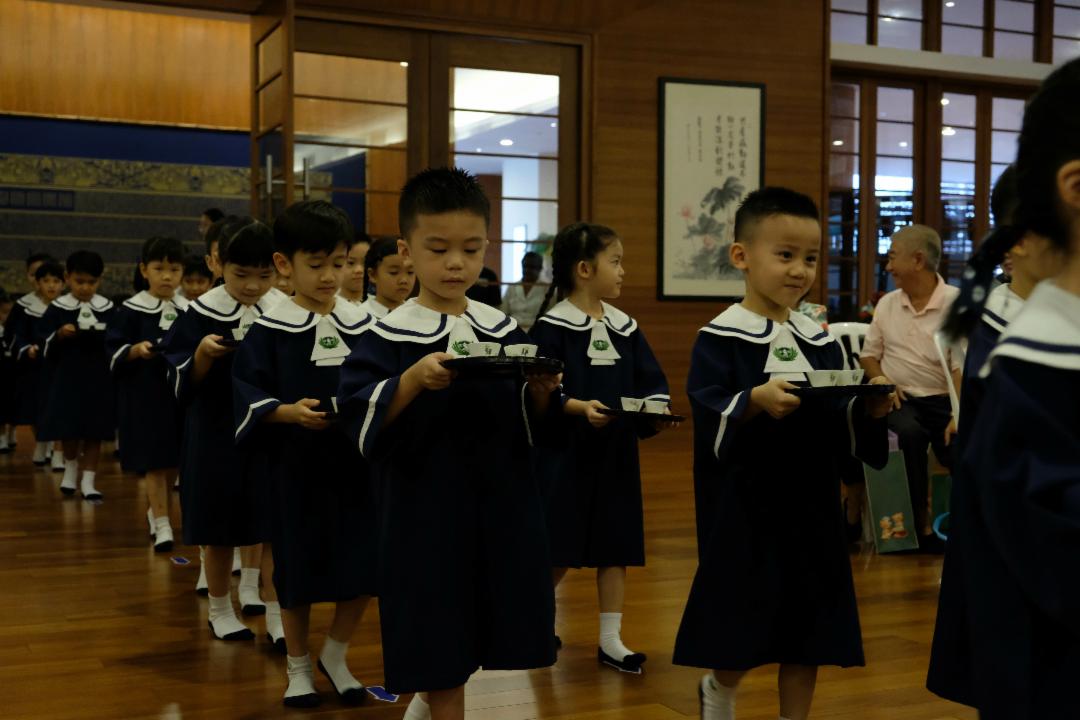
Before the performance began, 58 graduates, guided by their teachers, respectfully offered tea to their parents. Many parents were still swallowing the lump in their throats when a video recap of the children’s three-year journey was played. From innocence to independence, from timidity to courage, from receiving care to learning to give, their growth, step by step, filled the parents with gratitude and joy.
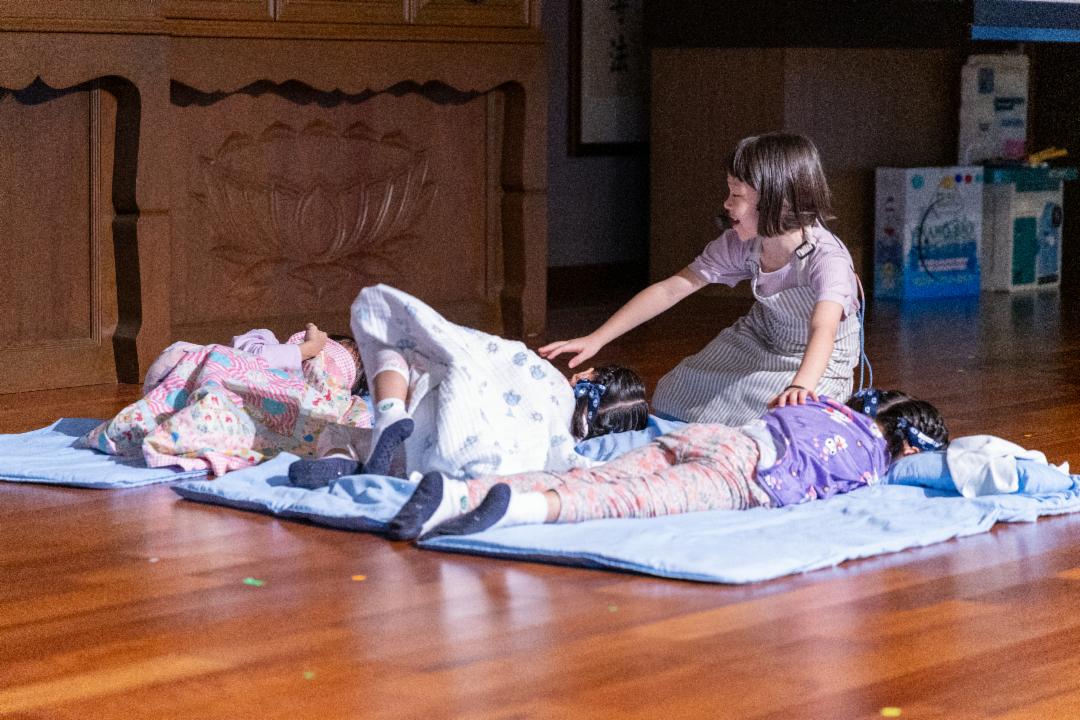
In “The Beginning”, the children narrated, in everyday language, the Buddha’s encounter with bones by the roadside and his dialogue with Ananda, leading naturally to the idea of enduring bonds with one’s parents. They also portrayed the ten months of a mother’s pregnancy – fatigue, discomfort, and the quiet strength that carries a child to birth.
“Children’s Wrongdoings” struck a lighter note. The children play-acted their own foibles: being disobedient, throwing tantrums, dawdling over meals, avoiding homework, squabbling with peers, and ignoring teachers’ advice. Parents and teachers chuckled, recognising the scenes all too well.
Then came the narrative lines that disarmed everyone:
“Parents hope their children stay healthy, yet they’re always worried and anxious.”
“Parents feel sad at times; they wish their children could be more obedient.”
“In their hearts, parents have just one wish – that their children listen, understand, and grow up happily.”
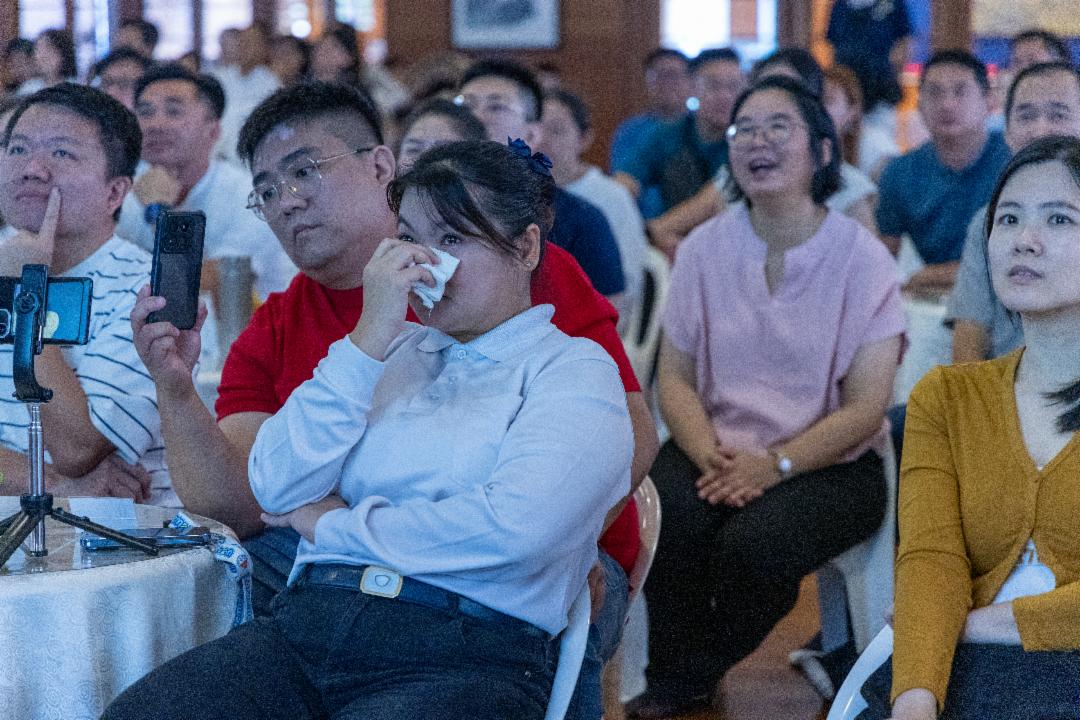
Suddenly, it was not just the children on stage being seen; it was every parent. Moved, some dabbed at their eyes.
In “Repaying Grace”, the story turned: the children helped with chores, cared for younger siblings, offered massages to their parents, and sang in gratitude. And then came the truth the performance had been leading towards: a parent’s love is higher than mountains and deeper than the sea; no calculator could ever compute it.
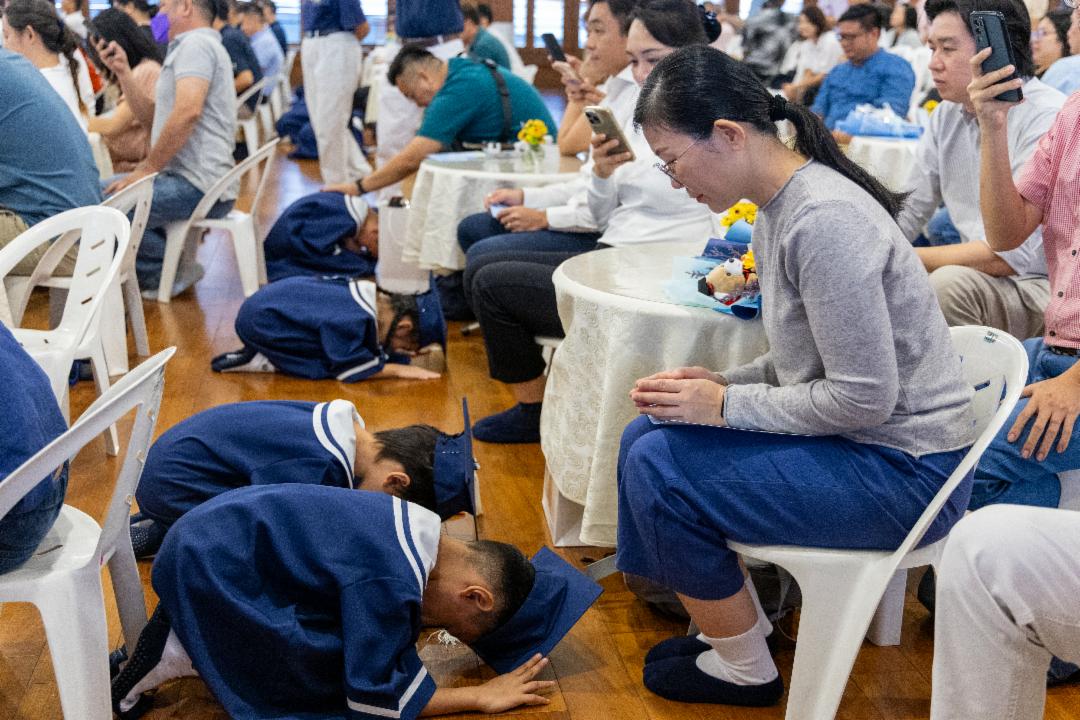
Throughout, the performance was presented from a child’s perspective. Their earnest expressions and tender voices deeply touched the audience. The most poignant moment came when the children knelt and bowed to their parents, singing, “To my dear parents, my heartfelt thanks to you,” as the “Kneeling Lamb” sign language performance drew to a close. Applause erupted; many mothers wept openly.
◎ ‘When I grow up, I’ll care for you’
Six-year-old Ting Guan Sean said candidly, “Mum cried as soon as she walked into the hall.” He believed they were tears of joy because she had seen him becoming more sensible and thoughtful.
He felt happy to graduate, yet reluctant to leave the teachers who had guided him for three years. He was grateful that they had nurtured him from one who was not good at drawing into someone who not only improved but grew to love it.
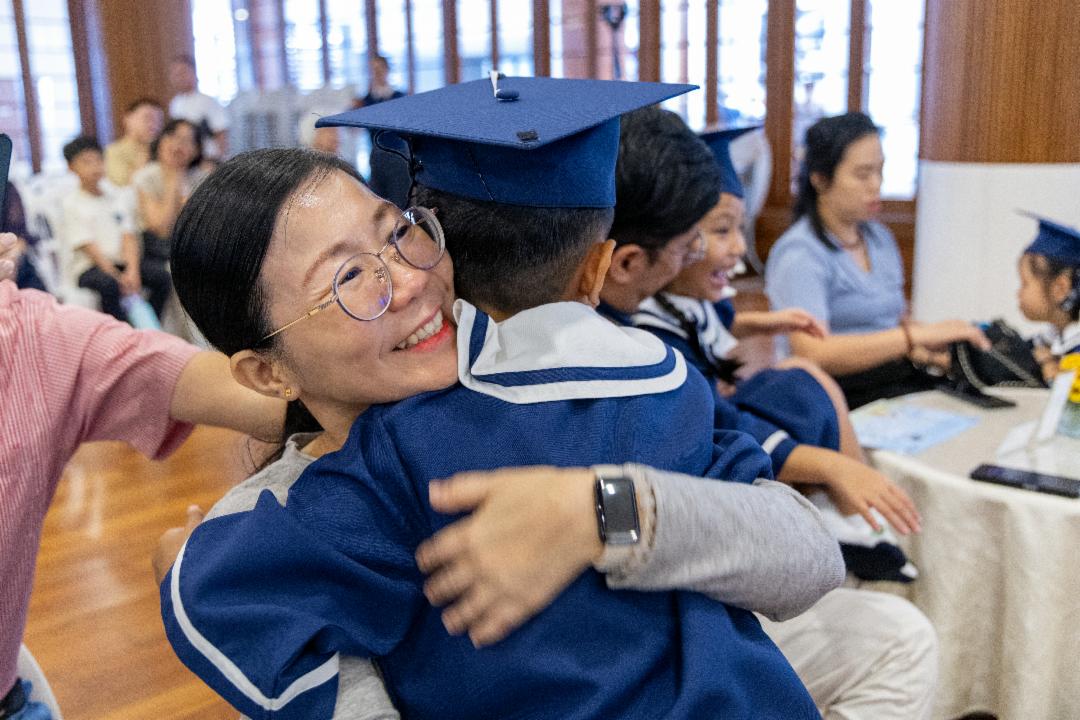
Besides participating in the “Kneeling Lamb” performance, little Guan Sean also accompanied his mother, Chai Lee Yuen, to share her feelings. He remembered seeing his mum shed tears the moment he looked up at her after performing the sign language rendition of “Thank You”, followed by a deep bow of gratitude. In that moment, he understood a little more: how hard it is to bring a child into the world and raise them day by day.
“Dad and Mum have been taking care of me since I was little. They have bathed me, washed my clothes, and cooked for me,” he said solemnly. “When you grow old and can’t walk, it will be my turn to bathe you and look after you.” His mother held him tightly, with relief and pride mingling on her face. It reflected what she had just said on stage: a child’s growing thoughtfulness and filial affection are what parents hope for most.

◎ ‘Mum, I’ll do it myself’
Lee Yuen remembered walking a small, clingy boy into Da Ai Kindergarten three years ago, worrying he would not adapt. Unexpectedly, within six months, the boy not only grew taller but also braver and more confident.
From one who used to rely on his mother, he now says, “Mum, I’ll do it myself.” It is a simple line, but to the mother, it is proof of quiet growth. She has watched him learn to socialise, share, care, and look out for others – calling a sick classmate to check in, reminding his grandmother about uneven pavements, and telling her to be careful when cutting vegetables. All these small things are threads in a fabric of care. The moment that moved her most was when he wrapped his arms around her and said, “Thank you, Mum. I love you!”
Lee Yuen felt that this year’s choice to include “Kneeling Lamb” was inspiring. Her son had never seen a lamb kneeling to suckle its mother’s milk; the teacher explained it as a gesture of utmost respect and gratitude, and told how parents would stand in doorways, waiting for children working far from home to return.
Curious, he asked, “Mum, when I grow up, will you wait for me at the door?” When she responded in the affirmative, he replied, “Then I’ll come back often. Or I’ll just work half-days and spend the other half with you.” She laughed, yet her heart was deeply moved. She is grateful that the teachers have guided the children with love and patience, and instilled a sense of gratitude in them. With primary school ahead, she trusts the seeds of love the teachers had sown will continue to grow.
◎ On stage again after 20 years
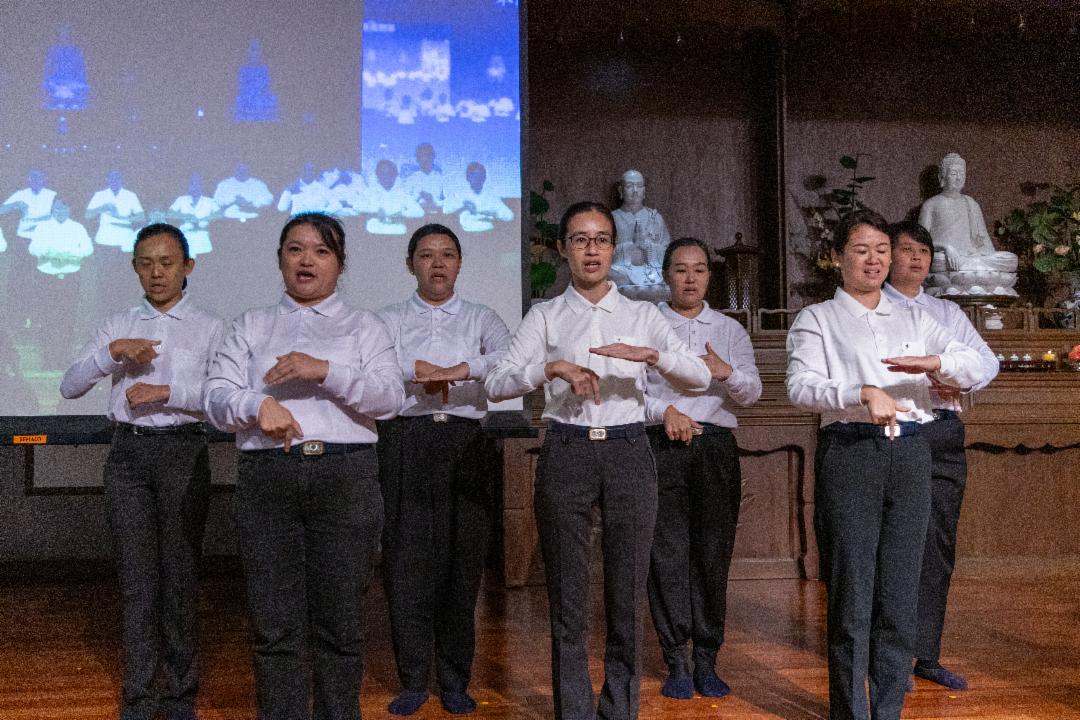
Ng Khang Li, a mother of three, attended to celebrate her youngest daughter’s graduation and to give a performance. She and 19 other mothers took to the stage to present a sign language rendition of the song “Repaying Grace” after the children’s presentation for the same segment.
Having participated in a “Sutra of Profound Gratitude to Parents” adaptation two decades ago as a Tzu Chi collegiate youth, she understood the essence of the sutra. She shared that back then, she made a private vow to enrol her children in Tzu Chi schools if she ever got married and had children, because she resonated with Tzu Chi’s education built on gratitude, respect, and love. Her eldest child did not secure a place, but the second and youngest eventually did.
She admitted that learning the sign language interpretation had been daunting. But thankfully, after two months of guided practice, the mothers moved in synchrony during the performance.
She was moved by the shared efforts, and even more by what her youngest daughter has learned over the past three years. Besides knowledge, she has learned to help with chores, wash her own socks and dishes, and fold her blanket each morning. At home, the little girl has also become a gentle advocate, reminding the family to save water and electricity because “the Earth is ill”, to love animals, and to abstain from eating meat.
Moreover, the little one would tell her mother, “Mum, your parents gave you life and raised you. You must thank them every day.” The lesson has clearly landed where it matters most: at home. Filial piety cannot wait; it must be timely.
◎ When teachings become relatable
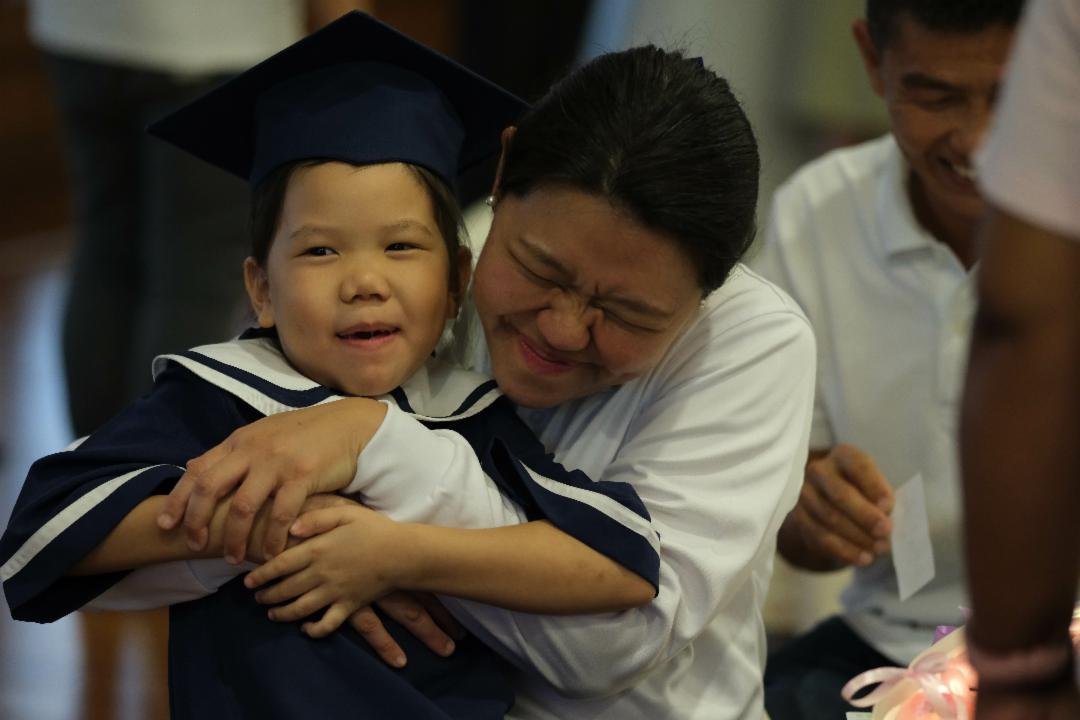
“This year’s graduation focused on expressing gratitude to parents. A child’s education depends not only on teachers, but just as much on parents,” said Principal Goh Tee Boon, visibly moved as families embraced, took photos, and lingered over the moment.
She was pleased that the children had come to feel the depth of parental love, and hoped that the mothers who participated in the “Repaying Grace” performance would also be reminded of the importance of honouring their own elders. After all, grandparents are often the ones fetching little ones to and from school; their kindness must never be overlooked.
Through the performance, the sutra teachings became more relatable to the children. She recalled passing a classroom where a teacher was explaining the storyline, and the usually playful children were sitting still, listening intently, showing signs of understanding the sacrifice and kindness of parents.
Watching the children perform “Kneeling Lamb” in unison and with strength, she felt a hush of solemnity settle over the hall. “May this feeling plant a seedling of love,” she said. “May they always remember not to let their parents’ hopes and kindness be in vain.”
She hopes the graduates will often return with their families to the Tzu Chi community, so that love and goodness continue to flow and become a true family treasure.

●
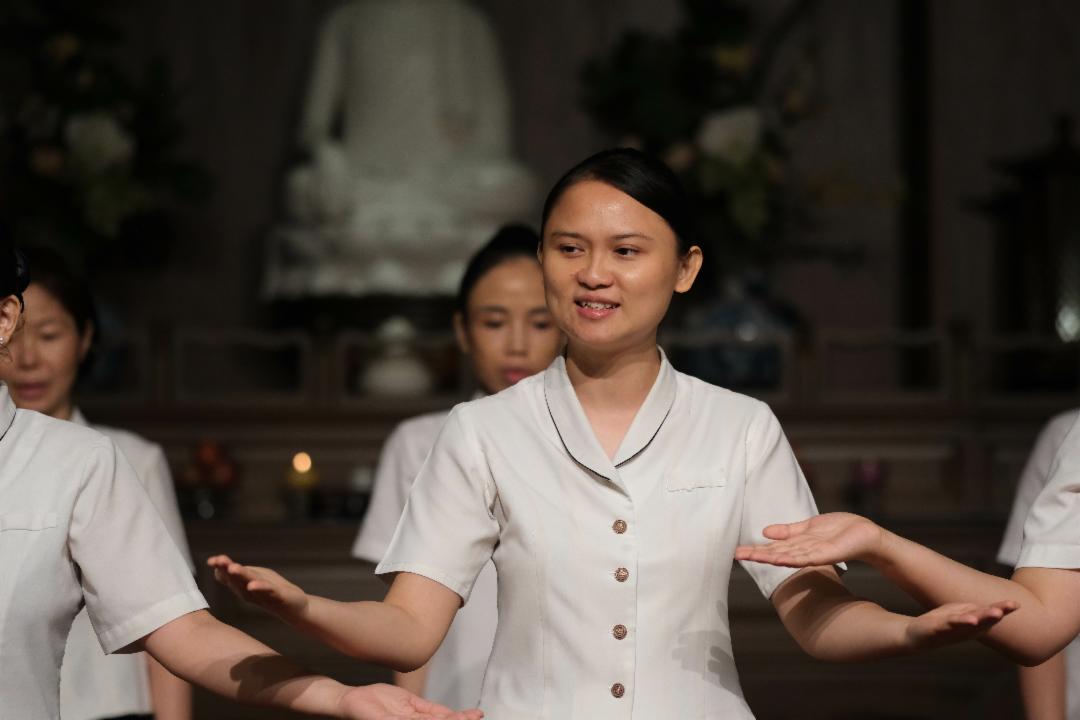
The ceremony concluded with the turning of tassels, the presentation of certificates, and the teachers’ sign language rendition of the song “Loving Reminders”. It was a tender, graceful full stop; and a doorway opening onto the road ahead.
